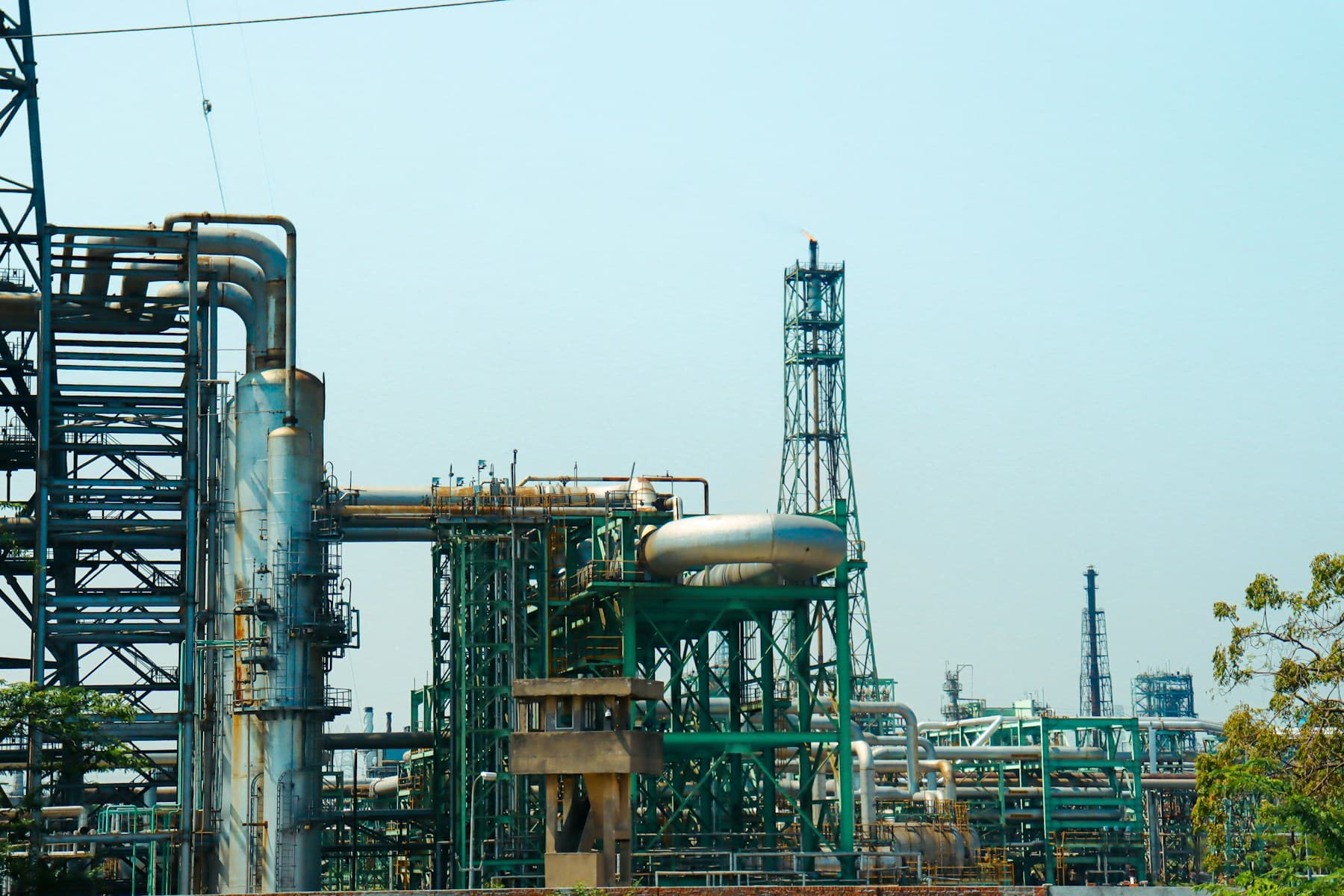
Process plant with interconnected industrial piping and vessels
Non-Metallic Solutions

Engineered to perform where metal fails.

Aggressive media eat through conventional steel. PTFE-lined, GRP and composite systems exist to stop that — and the right one starts with your process conditions.

Discuss your application
The corrosion story

01 · In service

A carbon steel line carries aggressive media.

Acids, chlorides and other corrosive process fluids sit in constant contact with the bare steel wall.

LEAKCARBON STEEL WALLSTEEL SHELL + PTFE / GRP LINERPROCESS MEDIA →CORROSION ISOLATEDIllustrative cross-section — not to scale. A lined system is a new installation, not a repair of corroded pipe.
Non-metallic solutions

The right barrier for the service.

Each technology has its own limits on temperature, pressure and chemistry. We help select the system that fits your process — not a one-size-fits-all answer.

PTFE / PFA-lined systems

A fluoropolymer liner inside a steel shell combines near-universal chemical resistance with the pressure rating and support of metal pipe.

  • Strong acids & alkalis
  • Chlorinated media
  • High-purity service

GRP / FRP piping

Glass-reinforced plastic is light, does not rust and resists many corrosive fluids — well suited to large-bore and buried lines.

  • Seawater & cooling water
  • Effluent & chemical drains
  • Large-diameter lines

Thermoplastic-lined (PP / PVDF)

Polypropylene or PVDF liners offer an economical barrier where temperature and chemistry sit within their range.

  • Moderate temperatures
  • Dilute acids
  • Process water

Composite & engineered systems

Matched pipe, fittings, valves and spools built as one system — so every wetted part is protected, not just the straight runs.

  • Lined valves & fittings
  • Custom spools
  • Retrofit packages

What we need to recommend a system

  • Media & concentration
  • Operating temperature
  • Pressure & vacuum
  • Line size & lengths
Corrosive-service fundamentals

Exposure, assessment, and a separate protective system.

An educational sequence showing why operating conditions come before material selection. It does not represent a Valorex product, a repair method, or an application-specific recommendation.

Stage 01

Fluid exposure inside a metal pipe

The internal metal surface meets the process fluid across the wetted flow path.

Fluid exposure inside a metal pipeIllustrative cross-section — not to scale.EXISTING METAL PIPE — EXPOSUREMETAL WALLPROCESS FLUIDThe wetted surface remains exposed along the flow path.Illustrative cross-section — not to scale.

Chemistry, concentration, contaminants, flow conditions, and operating cycles all influence how that exposure should be evaluated.

Stage 02

Localized corrosion

Attack may develop at particular areas rather than uniformly across the entire surface.

Localized corrosionIllustrative cross-section — not to scale.EXISTING METAL PIPE — CONDITION SHOWNLOCALIZED METAL LOSSEXISTING CORROSION REMAINS — CONDITION REQUIRES ASSESSMENTIllustrative cross-section — not to scale.

The illustration keeps the affected metal visible. It does not suggest that existing metal loss can be reversed by choosing another material system.

Stage 03

Material selection

Chemistry, temperature, and pressure are considered together before a system architecture is selected.

Material selectionIllustrative cross-section — not to scale.APPLICATION INPUTS — REVIEW TOGETHERSERVICECONDITIONSCHEMISTRYTEMPERATUREPRESSUREPTFE-LINED METAL ≠ GRP COMPOSITE — EVALUATE AS DISTINCT SYSTEMSIllustrative cross-section — not to scale.

A PTFE-lined metal system and a GRP composite system are distinct constructions with different design, joining, support, and suitability considerations. They are not interchangeable.

Stage 04

A separate new lined-pipe system

A newly specified lined pipe can place a protective barrier between the process fluid and its metal shell.

A separate new lined-pipe systemIllustrative cross-section — not to scale.SEPARATE NEW SYSTEMNEW LINED-PIPE CROSS-SECTIONMETAL SHELLPROTECTIVE BARRIERThe barrier is part of a newly specified system architecture.It does not repair the previously shown pipe.Illustrative cross-section — not to scale.

This is a separate new-system cross-section—not a transformation or repair of the corroded pipe shown earlier. Final material and system selection requires application-specific engineering review.

Application first

Share the service conditions before selecting a system.

Discuss your application
Home
Products
Industries
Contact
Design